

Understanding How Cooling, Orientation and Resin Selection Influence Film Properties
Pick up any plastic film — a shopping bag, a roll of pallet wrap, or a sealant layer inside a flexible package — and you are holding a material shaped by one of two major extrusion processes: blown film or cast film.
The first stage of film formation is not just a manufacturing detail. It strongly influences the final film properties, including clarity, toughness, thickness consistency, and processing performance.
At XH PACK, we work with polyethylene film materials every day, and we believe the blown-versus-cast discussion should go beyond price comparison. The better question is: which process best matches the required application?
Two Different Film Formation Processes
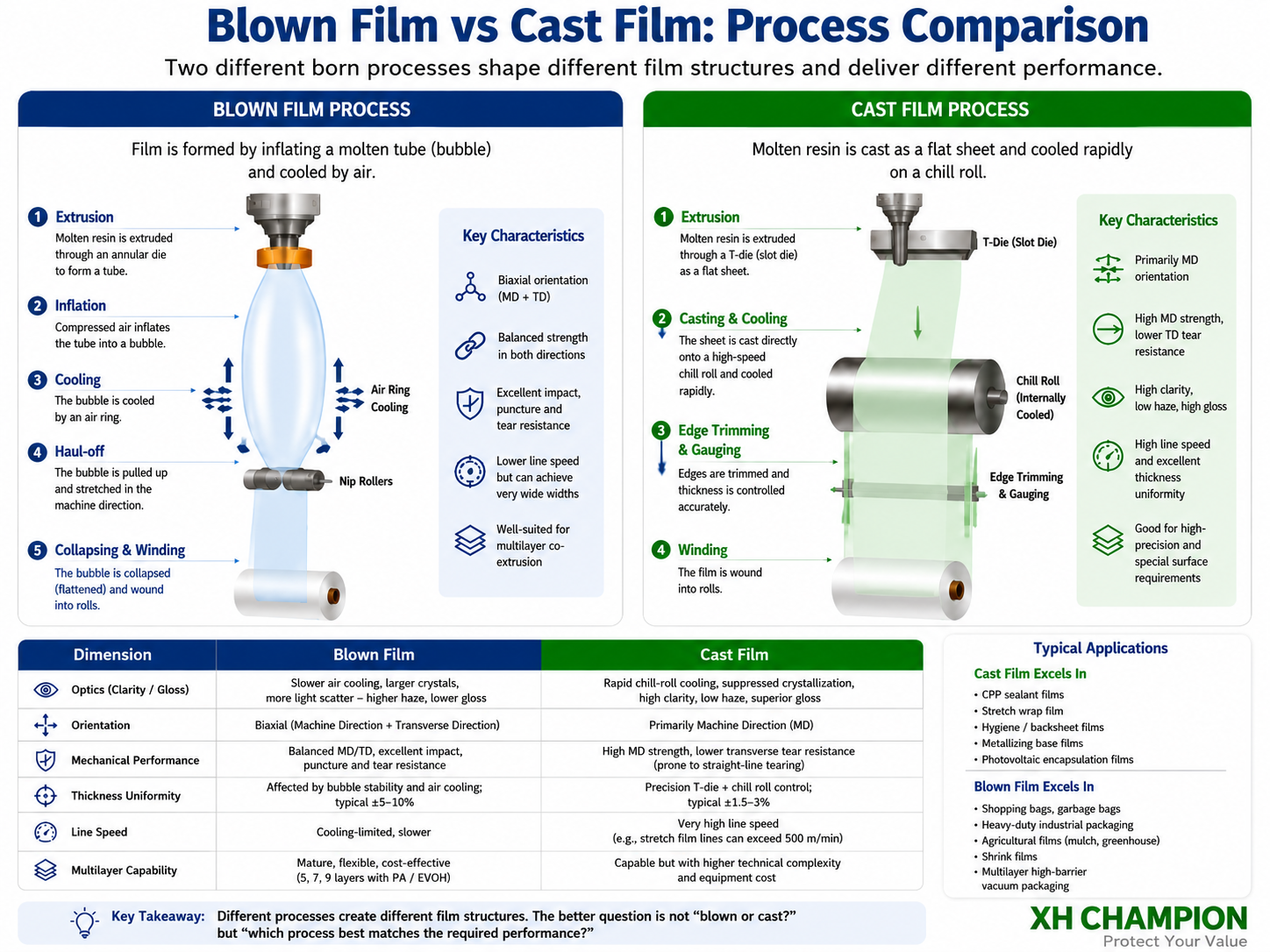
Blown film: the bubble process. Molten resin exits an annular die as a tube. Air inflates the tube into a bubble while cooling takes place through an air ring. The film is stretched in both the machine direction and transverse direction, creating biaxial orientation.
Cast film: the chill-roll process. Molten resin flows through a precision T-die and is rapidly cooled on a chilled roller. This provides excellent thickness control, flatness, transparency, and surface quality.
Why Cooling and Orientation Matter
Cooling speed influences film structure. Blown film cools gradually in air, while cast film is rapidly quenched on a chill roll. This difference affects crystallization, clarity, haze, and surface appearance.
Blown film often provides balanced mechanical properties in both directions. Cast film typically has stronger machine-direction orientation. Actual performance depends on resin selection, formulation, and processing conditions.
Film Performance Comparison
Optical performance:
Blown film is influenced by air cooling and crystallization, while cast film typically provides higher clarity, lower haze, and superior gloss.
Mechanical performance:
Blown film can offer strong puncture and tear resistance. Cast film provides excellent process control and consistency when designed for the application.
Thickness control:
Blown film depends on bubble stability and cooling control. Cast film benefits from precision T-die and chill-roll technology.
Production speed:
Modern cast film lines can achieve high production speeds depending on film structure and equipment configuration.
Where Each Process Fits Best
Cast film:
- Stretch wrap applications requiring clarity, stretchability, and efficient pallet unitization.
- Specialty films requiring flatness and surface quality.
Blown film:
- Industrial packaging where toughness and puncture resistance are important.
- Agricultural films, heavy-duty bags, and multilayer structures.
A Practical Decision Framework
The right choice depends on three questions:
- What does the end product require?
- What happens downstream during converting and application?
- What production economics match the order requirements?
Film selection should start with performance requirements, not simply process preference.
One More Variable: The Resin
Process choice is only part of the equation. Resin selection interacts strongly with film performance.
The same LLDPE grade can behave differently depending on extrusion process, film structure, and application requirements.
The best results come from matching resin, process, and application as one system.
The Bottom Line
Blown and cast films are not competitors so much as specialists.
Blown film is often the tough and flexible workhorse. Cast film is often the flat, clear, high-speed precision solution.
The key question is not simply “blown or cast?” The better question is: which process best matches the performance requirements of the application?
At XH PACK, we believe better packaging decisions start with understanding materials, processes, and real-world requirements.
Post time: Sep-15-2026