

Unveiling the Secrets of Adhesion
Abstract
Stretch film plays a critical role in cargo stability, transportation safety, and cost efficiency. However, end-users often encounter two extreme issues: insufficient adhesion or excessive stickiness. This article systematically analyzes the mechanisms of film adhesion, the root causes of adhesion failure, and practical solutions. It further explores application-based strategies for different industries, offering a scientific framework for selecting and applying stretch films effectively.
Keywords
Stretch film; adhesion; tack; packaging stability; PIB additive; cold chain
- Introduction
As a widely used packaging material, stretch film relies on its unique self-adhesive property to secure cargo during storage and transportation. Adhesion directly affects wrapping efficiency, film consumption, and logistics safety. Yet in real-world applications, users often complain about adhesion problems—films that do not stick at all, or films that are so sticky they hinder operations. Understanding adhesion mechanisms is therefore essential to improving performance and reducing costs.
- Mechanisms of Film Adhesion
2.1 Self-Adhesion
Stretch film adhesion prim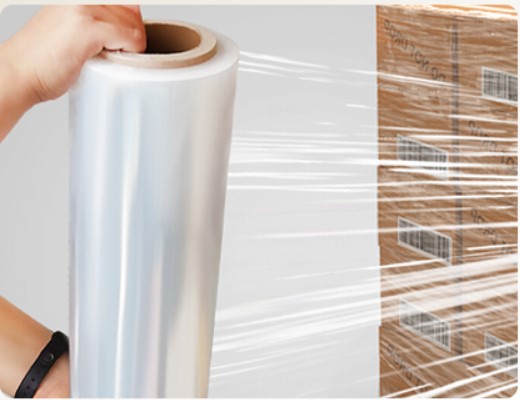 arily results from molecular attraction at the surface. To enhance this effect, manufacturers commonly add polyisobutylene (PIB) or use co-extrusion technology, which provides controlled adhesion while maintaining film transparency.
arily results from molecular attraction at the surface. To enhance this effect, manufacturers commonly add polyisobutylene (PIB) or use co-extrusion technology, which provides controlled adhesion while maintaining film transparency.2.2 Initial Tack
Initial tack refers to the immediate “grab” felt when the film contacts a surface. It is critical for high-speed wrapping operations, ensuring the film anchors securely from the first layer.
2.3 Holding Adhesion
Holding adhesion determines the film’s long-term stability during storage and transportation. This property prevents loosening or detachment under vibration, stacking pressure, or environmental changes.
- Causes of Adhesion Failure
3.1 Insufficient Adhesion
- Low-temperature environments (below 5°C) reduce molecular mobility.
- Insufficient PIB additive or uneven distribution.
- Dust, oil, or moisture contamination on the film surface.
- Excessive pre-stretching leading to reduced stickiness.
3.2 Excessive Adhesion
- High ambient temperature (≥30°C) softens PIB, making the surface overly tacky.
- Over-formulation of tackifiers.
- Improper storage under direct sunlight or high humidity.
- Excessive pressure during pallet stacking.
- Practical Solutions
4.1 Improving Low Adhesion
- Use stretch films with optimized PIB content.
- Preheat films when operating in cold-chain environments.
- Reduce excessive pre-stretch ratios.
- Store films in controlled environments above 10°C.
4.2 Reducing Excessive Adhesion
- Choose low-tack films or PE-based alternatives.
- Apply food-grade anti-blocking agents.
- Avoid exposure to direct sunlight during storage.
- Adjust machine parameters to reduce frictional heat.
- Application-Based Adhesion Strategies
- Cold Chain Logistics (-18°C): High tack + strong holding adhesion.
- Tropical Storage (>30°C): Low tack + medium holding adhesion.
- Heavy Load Stacking: High holding adhesion with reinforced tension.
- Automatic Wrapping Lines: Low tack + smooth inner layer for efficiency.
- Conclusion
Adhesion is the key performance indicator of stretch film, directly affecting logistics safety, packaging efficiency, and cost control. By understanding adhesion mechanisms, identifying failure causes, and applying targeted solutions, enterprises can achieve optimal packaging results. Tailored film selection ensures that goods remain secure throughout the supply chain, balancing efficiency and sustainability.
Post time: Nov-18-2025