

A Materials-Science Perspective on Reinforcement, Barrier Performance and Functional Film Design
Stretch film is often treated as a commodity: hold the load, resist punctures, cling to itself, and run efficiently on the wrapper. But the pressure on modern packaging is changing. Buyers increasingly want lighter gauges, better load security, lower material use, and more specialized functionality from the same film.
Nano-enabled stretch film is one response to that challenge. Instead of relying only on conventional polymer formulation, these films incorporate nanoscale reinforcements or functional structures to tailor how the film carries stress, resists gas or UV exposure, and behaves at the surface.
The opportunity is real, but the performance is not automatic. Actual gains depend on resin grade, nano-material selection, loading level, surface treatment, dispersion quality, layer design, and processing conditions. That is why nano stretch film is best understood as an engineering platform rather than a single product category.
1. What Is Nano-Enhanced Stretch Film?
Nano-enabled stretch films typically use PE-based matrices, while some emerging systems combine biodegradable or bio-based polymer matrices with nanoscale reinforcements. The defining feature is not the base polymer alone, but the use of materials or structures engineered at roughly the 1-100 nm scale.
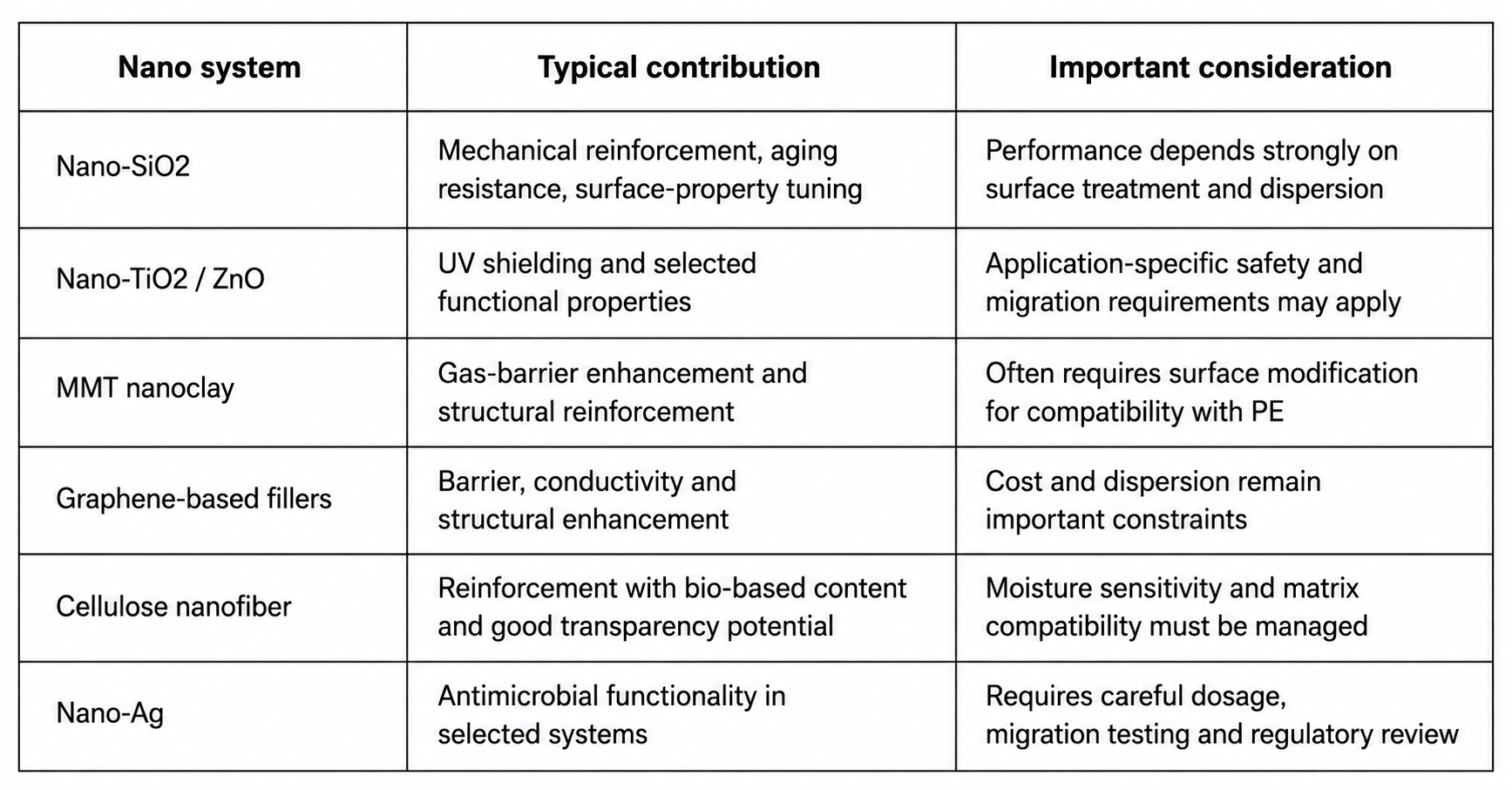
Common approaches include nano-SiO2, TiO2 or ZnO particles; layered nanoclays such as montmorillonite (MMT); graphene-based fillers; and cellulose nanofibers. In multilayer films, these components may be concentrated in a functional or core layer rather than distributed throughout the entire structure.
This targeted design matters because the goal is not simply to add nanoparticles. The goal is to place the right material in the right layer, at the right concentration, with enough dispersion and interfacial compatibility to create practical value.
2. How Nanomaterials Can Change Film Performance
A. Better Stress Transfer and Mechanical Reinforcement
Well-dispersed nanoparticles can improve interfacial stress transfer and reduce localized stress concentration within the polymer matrix. In selected formulations, this can support higher tensile strength, puncture resistance, modulus, or tear resistance. Published studies have reported meaningful improvements at relatively low filler loadings, but the magnitude of the gain varies widely with formulation and processing.
B. Longer Diffusion Paths for Barrier Performance
Plate-like materials such as nanoclay or graphene can create a more tortuous path for oxygen or water-vapor molecules moving through the film. Under controlled test conditions, selected systems have shown significant reductions in gas transmission. Any quoted barrier improvement should therefore be interpreted together with film thickness, temperature, humidity, test method, and filler dispersion.
C. UV and Aging Resistance
Nano-TiO2 and ZnO can contribute to UV shielding, while other nano-scale additives are being studied for thermal-aging resistance. For outdoor storage or long-distance transport, these functions may help preserve film performance when the formulation is properly designed and validated.
D. Functional Surfaces
Nano-enabled systems are also being explored for controlled tack, conductive behavior, contamination resistance, and antimicrobial functionality. For example, surface-modified nano-SiO2 can be used to tailor surface roughness and hydrophobicity. Nano-Ag and ZnO have been investigated for antimicrobial packaging applications, subject to formulation design, migration testing, and applicable food-contact or pharmaceutical regulations.
3. Key Nano Materials and Their Typical Roles
4. From Lab to Industrial Production
The technical challenge is often less about choosing the nano material than about dispersing it consistently and integrating it into an industrial process.
Common production routes include melt-blend extrusion, masterbatch dilution, multi-layer co-extrusion, and in some advanced systems, in-situ polymerization. For commercial stretch-film production, masterbatch and co-extrusion routes are especially attractive because they allow controlled dosing and targeted placement of functional materials.
However, nano fillers can agglomerate, increase viscosity, change thermal behavior, or create equipment-wear and safety considerations. Screw design, shear history, temperature profile, residence time, filtration, and occupational controls therefore become part of the material-design problem.
5. Where Nano Technology Can Create Real Value
Heavy and Sharp-Edged Loads
Higher puncture resistance and more controlled stress transfer may support downgauging or improved load containment for steel, machinery parts, and other demanding cargo.
Barrier-Sensitive Applications
Nanoclay or graphene-based structures may improve gas or moisture barrier performance where transmission control adds real value.
Outdoor and Long-Distance Logistics
UV-shielding systems may help reduce performance loss during prolonged sunlight exposure or harsh transport conditions.
Smart and Functional Packaging
Conductive or functional nano structures could support identification, sensing, anti-counterfeiting, or connected-packaging concepts.
Emerging Bio-Based Systems
Some research combines PLA, PBAT, cellulose nanofibers, or other renewable-content matrices with nanoscale reinforcements. These systems should be evaluated as application-specific end-of-life alternatives rather than assumed to be inherently more sustainable.
6. The Honest Challenges
Nano-enabled film is promising, but it adds complexity. The industry still has to manage particle agglomeration, formulation cost, equipment compatibility, worker exposure, migration testing, end-of-life considerations, and regulatory uncertainty in some applications.
This is why a commercially successful nano film must be judged by total system value. A technically impressive formulation is not automatically better if the added cost, processing difficulty, or regulatory burden outweighs the packaging benefit.
The more useful question is: where can nano technology create enough practical value to justify the added formulation and processing complexity?
7. What Comes Next
- Lower-cost and better-dispersed nano systems that deliver targeted performance at lower loading levels.
- More precise multilayer structures that place functional materials only where they are needed.
- Greater use of modeling, AI-assisted formulation design, SEM/AFM analysis, and molecular simulation to connect microstructure with film performance.
- More rigorous safety, migration, recyclability, and end-of-life assessment for nano-enabled packaging.
- Closer integration between downgauging, recycled-content strategies, functional additives, and next-generation polymer systems.
The Bottom Line
Nanotechnology gives film engineers another tool to tailor stress transfer, barrier properties, aging resistance, and surface functionality. But the value comes from disciplined material and process design—not from the word ‘nano’ itself.
The question is no longer whether nanotechnology can improve polymer-film performance. The more important question is where those improvements create enough practical value to justify the added formulation and processing complexity.
At XH PACK, we continue to study how polymer selection, multilayer design, additive systems, and real-world wrapping conditions interact. Our focus is not on chasing a label, but on understanding which technologies can deliver measurable packaging value under industrial conditions.
Which performance gap matters most in your operation: puncture resistance, load containment, barrier performance, aging resistance, or material reduction? We welcome the discussion.
Post time: Sep-03-2026