

An XH PACK knowledge share on choosing the right stretch film for your cargo, your process, and your environment
Ask any packaging buyer what they want to know first, and you will often hear the same questions: “How much per roll?” “How thick is it?” “Do you have it in stock?”
They are fair questions. But none of them tells you whether that film will actually protect your pallets.
Stretch film may look like a commodity, but application conditions vary widely. The same wrapping job can involve heavy export crates or lightweight e-commerce cartons; goods that are sensitive to moisture or static; loads that must breathe; and loads that need concealment. A film that performs well in one scenario may be inefficient or unsuitable in another.
So before comparing price and thickness, the questions that matter most are: What are you wrapping? How will you wrap it? And what will that pallet experience afterward?
At XH PACK, we approach stretch film selection from the application first. This guide summarizes the selection logic we use to help avoid common and costly buying mistakes.
First, What Does Stretch Film Actually Do?
Stretch film — also called stretch wrap, pallet wrap, or LLDPE stretch film — works through elastic recovery. As the film is stretched and wrapped, it contracts against the load, helping unitize cartons and goods while providing protection from dust, moisture, and surface scratches.
The basic mechanism is simple. The product family is not. Different film types are designed for different loads, wrapping methods, environments, and functional requirements.
The Stretch Film Family, Grouped by What It Solves
By how it is applied
- Hand stretch film — For manual wrapping in smaller warehouses, moving operations, carton fixing, and general dust protection. It requires no wrapping equipment and is commonly used for light to medium loads.
- Machine stretch film — For factories, logistics centers, and export operations wrapping pallets at volume. Consistency, puncture resistance, and controlled stretch performance are especially important because film breaks on high-speed wrappers can create downtime and waste.
- Pre-stretched film — Pre-stretched during production, so it generally requires less application force and, in suitable applications, can reduce film consumption. It is often used for lighter pallets and operations seeking to reduce operator fatigue.
- Mini stretch film — Small hand-held rolls used for bundling, sealing, furniture parts protection, and temporary fixing rather than full-pallet wrapping.
By what it reveals
- Clear film — A common choice when shipping marks, barcodes, labels, and product identification need to remain visible.
- Tinted transparent film — Useful for color-coding by customer, region, product type, or batch while retaining some visibility.
- Opaque film, especially black — Helps conceal pallet contents and reduce visual identification of high-value or branded goods during handling and transit.
By special function
- Anti-static or ESD-control film — For electronics, precision components, and static-sensitive industrial parts. The appropriate film depends on the required surface-resistance range and the application.
- Alternative end-of-life films — Some formulations are designed for specific recovery, recycling, biodegradable, or compostable pathways. Their environmental benefit depends on the material system, disposal route, local infrastructure, and applicable regulations.
- Flame-retardant film — Specialized formulations can help limit flame spread under defined test conditions. Performance should be evaluated against the applicable flame-retardancy standard and should not be interpreted as “fireproof.”
- Perforated or vented film — Allows airflow and moisture release, making it relevant for selected fresh-produce, plant, and cold-chain applications that require ventilation.
By core design
- Coreless and plastic-core film — Can reduce paper-core dust and debris, which may be useful in electronics workshops, cleanrooms, and other dust-sensitive packaging environments.
Start With the Cargo, Not the Film
Most purchasing mistakes begin with looking at the film before looking at the load. A practical selection process starts with cargo characteristics and the protection required.
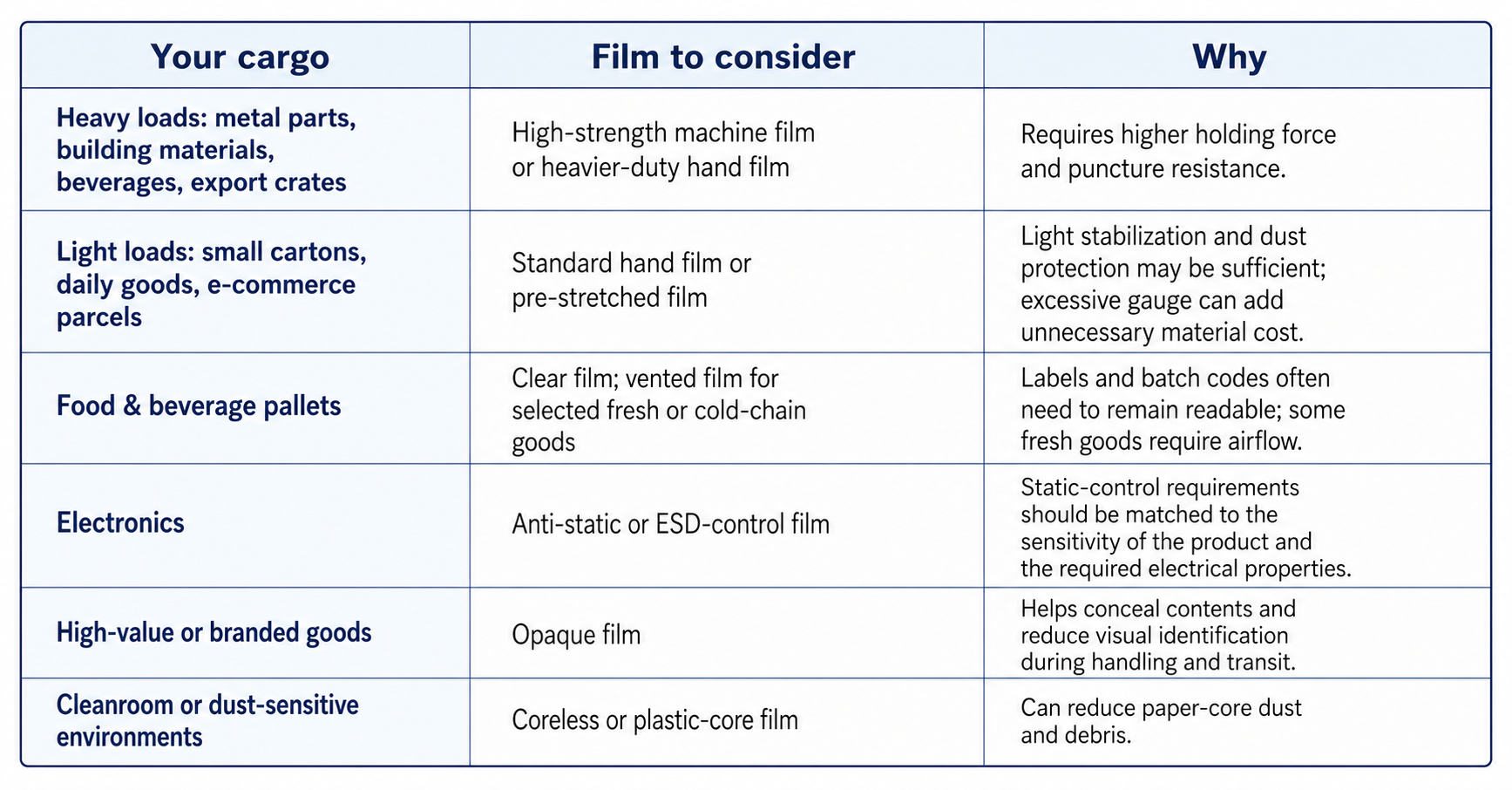
For heavy, unstable, or sharp-edged export loads, stretch film may need to work together with strapping, edge protectors, slip sheets, or other load-securing components. The right combination depends on the cargo and transport risk.
How You Wrap Changes What You Should Buy
- Manual operation? — Hand film keeps the process simple and flexible.
- High daily pallet volume? — Machine film can improve consistency and wrapping efficiency when matched to the wrapper and load profile.
- Small-item bundling or temporary fixes? — Mini film is usually the more practical tool.
For export pallets, think of wrapping as a system: pallet condition, film, load pattern, edge protection, strapping where needed, and the handling environment all influence final load stability.
About Specifications: Thickness Is Not a Score
Stretch film is available in a wide range of widths, gauges, roll weights, colors, and core designs. Common specifications vary by application, wrapping equipment, and market.
But thicker is not automatically better — it is simply thicker.
Using a heavy film on a light load can add unnecessary material cost. Using an under-specified film on a demanding load can lead to breaks, additional wraps, or insufficient containment. The right specification depends on cargo weight, pallet dimensions, edge conditions, transport distance, wrapping method, and the holding force required for the load.
The Cheap Roll That Ends Up Costing More
A low price per roll can hide important differences: net film weight, roll length, core weight, gauge consistency, stretch performance, puncture resistance, and the amount of film actually required per pallet.
The more meaningful metric is total wrapping cost per pallet. A useful comparison should consider net film weight, actual film consumption per pallet, break frequency, load containment, and whether the goods arrive intact.
A “cheap” roll that breaks frequently, requires extra revolutions, or loses load stability can become the more expensive option in real use.
A Five-Step Selection Framework
1. Cargo type — Heavy, light, fresh, electronic, high-value, sharp-edged, or dust-sensitive?
2. Packaging purpose — Load stabilization, dust/moisture protection, concealment, ventilation, static control, or small-item bundling?
3. Application method — Hand wrapping, machine wrapping, or mini-roll tasks?
4. Environment — Standard warehouse, cold storage, humidity, cleanroom, export container, or long-distance transport?
5. Then define the specification — Film type, width, gauge, roll weight, color, core, and any special functional requirement.
This sequence starts from the packaging problem rather than from a catalog number, making it easier to compare films on actual performance instead of price or gauge alone.
The Bottom Line
There is no single stretch film for every job. Heavy export cargo may need high-strength machine film; everyday warehouse cartons may only need standard hand film; fresh produce may require ventilation; electronics may require static control; high-value goods may benefit from concealment; and clean environments may require low-dust core designs.
The right stretch film is not the thickest or the cheapest one. It is the film that delivers the required load stability, protection, and cost efficiency for a specific application.
At XH PACK, we approach stretch film selection from the application first — then define the specification.
What matters most in your operation: load stability, film breakage, or cost per pallet?
Post time: Sep-03-2026